Endodontist Coventry – Root Canal Treatment That Saves Your Tooth
Angel Ognemirov, MSc Endodontics, provides root canal treatment, retreatment and tooth pain diagnosis for patients in Coventry and across the West Midlands — with particular care for anxious patients and a clear aim: keeping your natural tooth.
Book an appointment online, or call the practice directly.
Endodontics is the area of dentistry concerned with diagnosing and treating conditions affecting the dental pulp — the soft tissue inside the tooth — and the root canal system.
Deep decay, trauma, cracks or bacterial infection can cause the tissue inside a tooth to become inflamed or infected. In these situations, the first step is to identify the source of the problem and assess whether the tooth can be predictably preserved.
Our approach begins with diagnosis. Root canal treatment is recommended only when there is a clear clinical indication and when it represents an appropriate way to preserve the tooth.
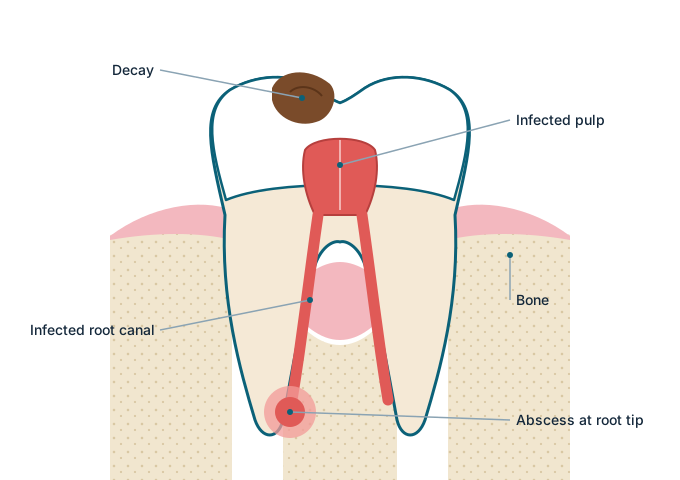
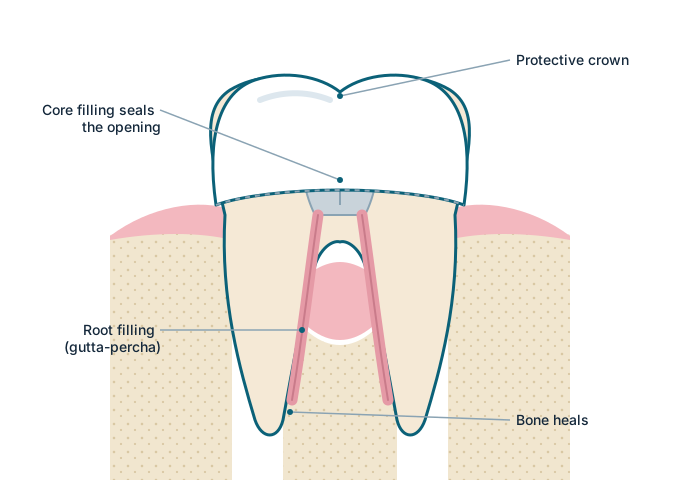
Before treatment: decay has reached the pulp and infection has spread to the bone around the root tip.
Endodontic treatment
Diagnosis and treatment for tooth pain, infection and root canal problems
Whether you require your first root canal treatment, retreatment of a previously treated tooth, or investigation of unexplained dental pain, every case begins with careful diagnosis.
Root canal treatment — also known as endodontic treatment — is used when the tissue inside a tooth becomes irreversibly inflamed or infected. The aim is to remove the source of infection, clean and disinfect the root canal system, and preserve the natural tooth where its condition allows.
New symptoms following previous root canal treatment do not automatically mean that the tooth must be extracted. In selected cases, root canal retreatment may allow the cause of the problem to be identified and the root canal system to be treated again.
Root canals are extremely small structures and their anatomy can be complex. A dental operating microscope magnifies and illuminates the treatment area, supporting more precise diagnosis and treatment.
A minor surgical procedure that treats persistent infection at the tip of the root when conventional root canal treatment or retreatment is not possible or has not resolved the problem.
Cracks in teeth can cause sharp pain on biting and sensitivity to cold. Early, accurate diagnosis under magnification helps decide whether the tooth can be saved and how.
Infection inside the tooth can extend into the tissues around the tip of the root. For some patients this causes pain or swelling. In others, it may only become apparent on an X-ray.
See every service the practice offers — including cracked tooth assessment and the care of injured teeth — with a plain explanation of what each involves.
Before recommending treatment, we focus on identifying the cause of your symptoms. Your assessment may include clinical tests, examination of the surrounding tissues and appropriate dental imaging.
Treatment under a dental microscope
Magnification and focused illumination improve visibility of the complex internal anatomy of the tooth and support controlled, precise treatment.
Focus on preserving the natural tooth
Where a tooth can be predictably restored, we carefully assess the possibility of preserving it before extraction and replacement are considered.
Modern endodontic techniques
Our treatment protocols are designed around precise canal preparation, thorough disinfection and effective sealing of the root canal system.
Individual treatment planning
Two teeth can produce similar symptoms while requiring very different treatment. Your plan is based on your diagnosis, the anatomy of the tooth, its restorability and the long-term outlook.
Comfort and clear communication
We explain what we have found, what treatment involves and what you can expect afterwards. Local anaesthetic is used for treatment, and patients who feel anxious are encouraged to tell us before the procedure.
Your treatment journey
From diagnosis to restoration
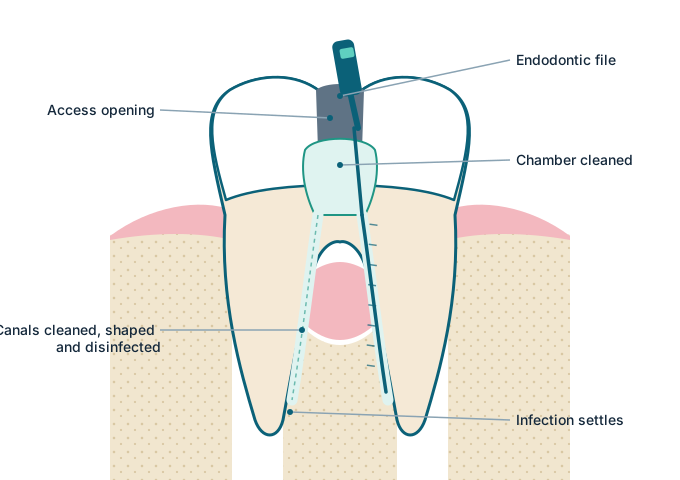
During treatment: the infected tissue is removed and the canals are cleaned, shaped and disinfected under the microscope.
Consultation and diagnosis
We begin by discussing your symptoms, examining the tooth and carrying out any diagnostic tests or imaging that may be required.
Understanding your options
We explain the diagnosis, whether the tooth can be preserved, and which treatment options are appropriate for your situation.
Endodontic treatment
Where root canal treatment is required, the procedure is carried out under local anaesthetic with the tooth isolated from the rest of the mouth. Magnification allows careful treatment of the root canal system.
Restoration and follow-up
Following endodontic treatment, the tooth will require an appropriate final restoration. Where indicated, a review appointment may also be recommended.
Dental pain can have several different causes and does not always mean that root canal treatment is required. If you have severe spontaneous pain, lingering sensitivity to hot or cold, pain when biting, or swelling, an examination is needed to identify the source of the problem.
If your symptoms are acute, please tell us when you first contact the practice.
Important: rapidly increasing facial swelling, difficulty swallowing or breathing, or severe systemic illness requires urgent medical assessment — contact NHS 111 or emergency services.
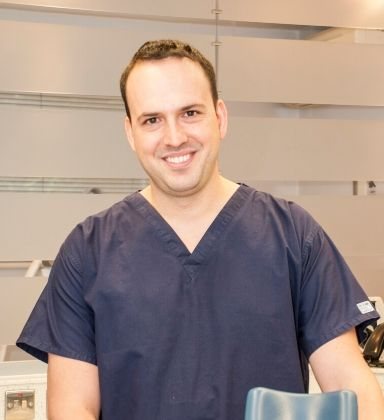
Angel Ognemirov holds an MSc degree in Endodontics from the University of Chester and has completed training in oral and intravenous dental sedation at Guy's Hospital in London. He is also certified in Restorative Dentistry and is an active member of the Society for the Advancement of Anaesthesia in Dentistry (SAAD).
His practice is built around patients who find dental treatment stressful. Appointments are unhurried, every step is explained before it happens and comfort is checked throughout — so that root canal treatment, a procedure many people fear, becomes a calm and manageable experience.
Angel's clinical focus is on preserving natural teeth: accurate diagnosis, modern root canal treatment and retreatment, and honest advice about what each tooth can and cannot be expected to do. Patients come from Coventry and across the West Midlands, and are welcome by referral or by contacting the practice directly.
MSc in Endodontics, University of Chester
Training in oral and intravenous dental sedation, Guy's Hospital, London
Certificate in Restorative Dentistry
Member of SAAD (Society for the Advancement of Anaesthesia in Dentistry)
The root canal system can be extremely small and anatomically complex. Canals may be narrow, curved, calcified or difficult to identify without magnification.
A dental operating microscope provides high magnification and concentrated illumination directly over the treatment area. This supports detailed visualisation of the internal anatomy of the tooth and allows more controlled treatment.
Depending on the clinical situation, treatment may also involve electronic working-length measurement, ultrasonic instruments, modern canal preparation systems, activated irrigation and appropriate dental imaging.
Technology does not replace clinical judgement. It helps us apply that judgement with greater precision.
Being told that a tooth has an infection or that a previous root canal treatment has failed does not automatically mean that extraction is the only option.
In some cases, primary root canal treatment or root canal retreatment may allow the tooth to be preserved. In other situations, a significant crack, insufficient remaining tooth structure or another structural problem may make the long-term outlook less favourable.
Our role is to assess the individual tooth carefully and explain the realistic options available to you.
Root canal treatment is carried out under local anaesthetic, and the aim is for you to remain comfortable during the procedure. Some temporary tenderness or sensitivity when biting can occur afterwards.
How long does root canal treatment take?
The length of the appointment depends on the tooth and the complexity of its root canal system. Some cases can be completed in a single visit, while more complex or infected teeth may require additional treatment time.
How many appointments will I need?
Many root canal treatments can be completed in one appointment. More complex cases, retreatment, or teeth with significant infection may require two or more visits.
Why is a microscope used?
A dental microscope magnifies and illuminates the inside of the tooth. This can help identify narrow, additional or difficult-to-access canals and supports more precise treatment.
When is root canal retreatment needed?
Retreatment may be considered when a previously treated tooth develops new symptoms or when imaging shows evidence of persistent or recurrent infection around the root.
Can an infected tooth be saved?
Often, yes — but it depends on the condition of the roots, the amount of healthy tooth structure remaining, the presence of cracks, and whether the tooth can be predictably restored.
What should I expect after treatment?
Mild tenderness or discomfort when biting may occur for a short period after treatment. If pain becomes worse, swelling develops, or you are concerned about your recovery, contact the practice.
Will I need a crown after root canal treatment?
This depends on the tooth and how much sound tooth structure remains. Back teeth commonly require a protective restoration to reduce the risk of fracture. Your dentist or clinician will advise you based on your individual case.
Does every painful tooth need root canal treatment?
No. Dental pain can come from several different structures, and sometimes pain may appear to come from a tooth that is not actually the source of the problem. This is why diagnosis should come before treatment.
How do I know if I have a root canal infection?
Possible symptoms include spontaneous pain, pain when biting, prolonged sensitivity to hot or cold, swelling, or a small draining spot on the gum. Some infections, however, may cause few or no obvious symptoms.
What is the difference between an endodontist and a general dentist?
Endodontics is the area of dentistry focused on diagnosing and treating conditions affecting the dental pulp and root canal system. Endodontists concentrate on this work and use equipment such as the operating microscope routinely.
What happens if an infected tooth is left untreated?
An untreated infection may persist or spread into the tissues around the root. Symptoms can sometimes temporarily improve, but this does not necessarily mean that the underlying problem has resolved.
Your next step
Ready to save your natural tooth?
Have questions about root canal treatment or need to arrange an appointment? Get in touch by phone to discuss your next steps.